

Why organisations need to rethink leadership capability, behavioural performance and sustainable decision-making under pressure.
Introduction
For years, burnout has been framed as an individual problem.
People need better resilience. Better coping strategies. Better wellbeing support.
However the conversations emerging across Australia tell a much bigger story.
The recent ABC burnout article highlighted growing concern around workplace pressure, stress claims and accountability. At the same time, discussions around “job hugging” are exposing another hidden organisational issue: people staying in roles they no longer feel energised by because uncertainty, economic pressure and AI disruption are increasing fear, fatigue and risk avoidance.
People are still showing up. Still attending meetings. Still delivering outcomes.
However underneath the surface, many leaders and teams are operating in survival mode.
Many organisations are now seeing leadership capability decline under prolonged pressure, impacting communication, decision-making, workforce effectiveness and sustainable business performance long before burnout becomes visible.
However underneath the surface, many leaders and teams are operating in survival mode.
The Real Risk Is What Happens Before Burnout
One of the biggest mistakes organisations make is waiting until burnout becomes visible.
By the time people are exhausted, disengaged or leaving, the impact on performance has often been building for months or years.
What organisations are ignoring is what prolonged pressure is doing to how people think, communicate and lead.
When pressure becomes chronic, the brain starts prioritising short-term survival over strategic thinking. Leaders become more reactive. Communication narrows. Decision-making becomes slower or emotionally charged. Teams spend more time managing pressure and less time creating momentum.
Most organisations still measure output, deadlines and utilisation while missing what prolonged pressure is doing underneath the surface.
The hidden cost is not simply burnout. The hidden cost is leadership capability decline.
Many Organisations Are Not Losing Talent. They Are Losing Capacity.
Many organisations are not losing capability because people lack intelligence, technical expertise or ambition. They are losing capability because prolonged pressure is reducing people’s ability to think clearly, communicate effectively and lead consistently under pressure.
This creates hidden organisational costs that often go unnoticed initially: slower execution, inconsistent leadership, communication breakdowns, reduced collaboration, lower discretionary effort and increased fatigue masked as productivity.
Leaders today are carrying constant decision pressure, AI and transformation demands, leaner teams and rising expectations with fewer resources.
At the same time, HR leaders are navigating retention concerns, psychosocial risk, capability gaps, workforce fatigue and pressure to maintain engagement and performance with tighter budgets.
Many are quietly asking the same question:
“How do we sustain performance without running people into the ground?”
That is the real leadership conversation emerging now.
Not simply burnout prevention.
Not another wellbeing initiative.
This is becoming a leadership capability and workforce effectiveness issue.
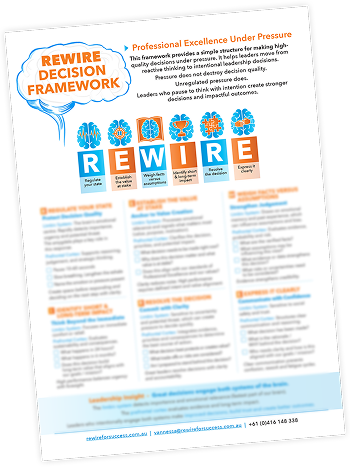
Make Clear, Confident Decisions – Even Under Pressure
A simple neuroscience-based framework leaders use to move from reactive thinking to intentional decisions.
A one-page decision tool you can apply in seconds during high-stakes leadership moments.
Make Clear, Confident Decisions – Even Under Pressure
A simple neuroscience-based framework leaders use to move from reactive thinking to intentional decisions.
A one-page decision tool you can apply in seconds during high-stakes leadership moments.
Organisations Have More Learning Than Ever Before. So Why Is Leadership Behaviour Still Struggling?
We now have unlimited access to AI-driven tools, digital learning platforms, leadership content and on-demand information. However leadership behaviour, communication and performance under pressure are still not translating consistently into day-to-day practice.
Why?
Because awareness alone does not create behavioural change.
Knowledge alone does not rewire habits.
And content consumption alone does not improve communication, emotional regulation or decision-making under pressure.
The brain wires through repetition, emotional relevance, reflection, accountability and practical application over time.
This is why many organisations are discovering that scalable learning alone is not enough.
The issue is no longer access to information. The real challenge is helping leaders translate knowledge into consistent day-to-day behaviour under pressure.
Sustainable performance under pressure requires behavioural consistency, not simply access to more information.
Leadership capability under pressure is becoming a significant business risk, particularly when organisations are expecting leaders to navigate increasing complexity, AI disruption and workforce fatigue without strengthening the behavioural habits that support communication, decision-making and sustainable performance.
That is where organisations need to rethink how leadership capability is developed moving forward.
AI Is Accelerating Pressure Faster Than Most Organisations Realise
AI is creating extraordinary opportunities for productivity and innovation.
However it is also accelerating the pace of change, information overload, workforce uncertainty and decision fatigue.
Leaders are now expected to process faster, adapt faster and lead through continuous uncertainty while still maintaining engagement, communication quality and performance.
At the same time, many organisations are reducing traditional leadership budgets and shifting toward scalable, lower-cost learning models.
That makes commercial sense.
However it also creates risk if behavioural implementation, accountability and human capability are not strengthened alongside it.
Because AI will never replace emotional regulation, trust, communication quality, leadership judgement or psychological safety.
Those capabilities are becoming more valuable, not less.
Leadership Capability Under Pressure Is Becoming a Business Risk
The organisations gaining traction right now are focusing less on one-off inspiration and more on behavioural capability under pressure.
They are strengthening:
• communication quality
• leadership consistency
• decision-making under pressure
• emotional regulation
• practical behavioural habits
• accountability and implementation over time.
One recent leadership program achieved a 21.25% uplift across 10 leadership capability measures in four months.
The biggest insight?
Small shifts in how leaders think, communicate and operate under pressure create significant ripple effects across engagement, collaboration, trust, workforce effectiveness and sustainable performance.
That is where meaningful change starts.
What Leaders Can Apply Immediately
There are three practical shifts leaders can apply immediately.
- Stop measuring performance only by output. Pay closer attention to communication quality, emotional regulation, collaboration and decision-making consistency under pressure.
- Create space for reflection before reaction. The brain does not perform at its best in constant urgency. Even small pauses improve thinking quality and reduce emotional reactivity.
- Focus on behavioural consistency rather than information overload. Sustainable performance comes from repeated high-performing habits and practical application, not simply more content.
The organisations that move early on this will create a significant leadership advantage over the next decade.
Final Thought
Pressure itself is not the problem.
The bigger risk is prolonged pressure impacting how people think, communicate and lead while organisations continue pushing for performance.
And in many organisations, that capability decline is already happening underneath the surface.
The question is no longer:
“Are people resilient enough?”
The better question is:
“What are prolonged pressure and cognitive overload already costing your organisation?”
If this conversation resonates with the challenges your leaders or teams are navigating, let’s connect.
I work with organisations to strengthen leadership capability, behavioural performance and sustainable decision-making under pressure using practical neuroscience-based strategies that create measurable outcomes.
www.rewireforsuccess.com.au
Book 30min strategy call to explore your situation: https://calendly.com/rewireforsuccess/30min-strategy-call-1