


There is a moment many capable professionals recognise.
They sit down at the start of the day with a clear intention. There is an important piece of work to complete, a decision to make or a conversation that needs their full attention.
Then the day begins.
An urgent email arrives. A meeting runs over. A colleague needs an answer. A customer issue escalates. Priorities shift. Another change is announced.
By mid-morning, the plan has disappeared.
They keep going.
They respond, solve, attend, decide and move from one demand to the next. From the outside, they look productive. They are busy, committed and still delivering.
By the end of the day, they are mentally exhausted.
The important work remains unfinished. The difficult decision is still sitting there. They have spent the day working hard, yet feel they have not moved forward on what matters most.
This is not simply an individual productivity problem.
When this pattern is repeated across an organisation, strategic work slows, decision quality declines and change becomes harder to implement. Capable people remain busy, yet the organisation receives less of the judgement, creativity and leadership capability it needs from them.
The issue is not a lack of ability, experience or commitment.
The environment has changed faster than many people’s habits have changed with it.
The hidden gap between capability and performance
One of the biggest risks for organisations is that overload does not always look like poor performance.
It can look like dedication.
The employee stays late. The leader joins every meeting. The manager answers messages immediately. The high performer takes on one more responsibility because they know it needs to be done.
They remain dependable, which means they are often given even more.
Over time, the gap between what they are capable of and what they can consistently access begins to widen.
They still know how to think strategically, yet rarely find the space to do it.
They still know how to make sound decisions, yet the volume of decisions leaves them questioning choices they have already made.
They still know how to communicate well, yet pressure makes them more reactive, less patient or more likely to avoid the conversation altogether.
Their capability has not disappeared.
It has become harder to access under the weight of constant cognitive demand.
This is the hidden performance gap many organisations miss.
Capable people do not always need more information, motivation or pressure. They often need a better way to manage their attention, decisions and behaviour in a more demanding environment.
When every demand competes for attention
The brain is our greatest asset.
It enables us to solve problems, weigh risks, communicate, imagine possibilities and decide what action to take next.
It also has limits.
Every interruption, meeting, notification and change in direction requires attention. Even small demands draw on the same mental resources needed for strategic thinking, emotional regulation and complex problem-solving.
This is why a capable person can make high-quality decisions early in the day and struggle with a relatively simple choice later.
It is also why people often become more reactive as pressure increases.
The brain looks for efficiency. It narrows attention, prioritises what feels urgent and relies on familiar responses. This conserves energy in the short term, yet can quietly reduce the quality of thinking and behaviour.
A person may respond to the loudest demand rather than the most important one.
They may repeatedly check email because it creates a sense of progress.
They may revisit decisions because they no longer trust their judgement.
They may delay a difficult conversation because immediate tasks feel easier to manage.
None of this means they are failing.
It means their brain is responding in a predictable way under pressure.
The problem begins when pressure becomes the normal way of working.
Performance declines before burnout becomes visible
Organisations often wait for burnout to become obvious.
By then, the decline has usually been happening for some time.
Before someone says, “I cannot keep doing this,” there are often quieter signs.
Focus becomes fragmented. Energy becomes inconsistent. Decisions take longer. People stop contributing ideas. Patience decreases. Employees become hesitant about anything unfamiliar. Leaders spend more time reacting and less time looking ahead.
These changes affect far more than wellbeing.
They influence execution, productivity, customer experience, leadership consistency and the organisation’s ability to deliver change.
When people are overloaded:
- important work slows down
- decisions are delayed or repeatedly reopened
- communication becomes less clear
- mistakes and rework increase
- teams lose momentum
- leaders spend more time resolving avoidable issues
The commercial impact can be significant long before anyone uses the word burnout.
The habit that helped you succeed may now be holding you back
This became very real for me through perfectionism.
For many years, perfectionism helped me succeed.
It drove high standards. It helped me prepare thoroughly, pay attention to detail and deliver work I was proud of. In a demanding corporate environment, those behaviours were rewarded.
Then I reached a point where the same habit that had supported my success began to limit it.
Perfectionism made it harder to delegate. It increased the time I spent refining work that was already strong. It created pressure to have every answer before moving forward. It kept me focused on getting things right rather than creating space to think differently, lead more strategically and trust others.
The habit had not suddenly become bad.
The environment had changed. My responsibilities had changed. The way I needed to perform had changed.
What helped me reach one level had become part of the glass ceiling preventing me from reaching the next.
Many habits are not inherently helpful or unhelpful. Their value depends on the context.
A leader who built their reputation by always being available may now need stronger boundaries to focus on strategy.
A manager who solved every problem for their team may now need to coach others to make decisions.
A high performer who relied on working longer hours may now need to protect their energy and prioritise more deliberately.
A professional who said yes to every opportunity may now need to decide which opportunities deserve attention.
The question is not:
Is this a good habit or a bad habit?
The better question is:
Does this habit still support how I need to perform now?
Why people return to old patterns
Habits are essential to performance.
They allow the brain to complete familiar actions without using conscious effort every time. This creates efficiency and frees mental capacity for more complex tasks.
The same mechanism can also hold people back.
People often know they need to work differently. Yet when pressure rises, they return to what is familiar.
This is why information alone rarely changes behaviour.
Someone can attend a workshop, understand the concept and feel energised to change. Then Monday arrives. The inbox fills. The meetings begin. The urgent requests return.
The old pattern takes over.
Sustainable change requires more than insight.
It requires deliberate practice, repeated action and enough time for a more effective response to become familiar.
This is why focusing on one to three meaningful habits creates greater impact than attempting to change everything at once.
People do not need a complete personal overhaul.
They need to identify the small number of behaviours having the greatest influence on how they think, decide and perform.
Adapting faster does not mean working faster
One of the most damaging assumptions in modern work is that adaptability means moving at greater speed.
It does not.
Adaptability is the ability to recognise that the situation has changed and adjust your thinking, behaviour or priorities accordingly.
Sometimes that means acting quickly.
Sometimes it means slowing down long enough to make a better decision.
The most adaptable people are not those who respond to everything immediately. They are the people who can pause, assess what matters and choose their response rather than allowing pressure to choose it for them.
They can notice when an old habit is no longer helping.
They can distinguish genuine urgency from noise.
They can redirect attention when priorities change.
They can remain intentional when the environment becomes reactive.
This is not a fixed personality trait.
It is a set of behaviours that can be strengthened.
One action to apply today: the five-minute REWIRE reset
Start by identifying one recurring pressure point and changing the response attached to it.
Take five minutes and work through these questions:
1. Recognise the pattern
What repeatedly causes you to lose clarity, focus or momentum?
2. Identify the automatic response
What do you usually do when that pressure point appears?
3. Assess the impact
Does that response help you progress what matters, or does it create more noise, delay or rework?
4. Choose one better response
What small action can you repeat the next time the trigger appears?
5. Practise it for seven days
Do not change everything. Build consistency around one meaningful behaviour.
For example, an urgent request may arrive while you are working on an important priority.
Your automatic response may be to stop immediately and deal with it.
A more effective response may be to pause, assess the true urgency and confirm when you will respond.
The value comes from applying the new response repeatedly.
One different choice will not automatically change a habit.
Repeated choices begin to create a new pattern.
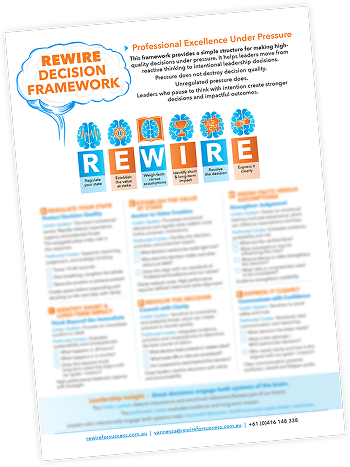
Make Clear, Confident Decisions – Even Under Pressure
A simple neuroscience-based framework leaders use to move from reactive thinking to intentional decisions.
A one-page decision tool you can apply in seconds during high-stakes leadership moments.
Make Clear, Confident Decisions – Even Under Pressure
A simple neuroscience-based framework leaders use to move from reactive thinking to intentional decisions.
A one-page decision tool you can apply in seconds during high-stakes leadership moments.
Organisations shape the habits people rely on
Building adaptable people requires more than asking individuals to manage pressure better.
People do not operate in isolation.
Work environments teach people how to behave.
When every request is treated as urgent, people learn to remain constantly available.
When calendars are filled with back-to-back meetings, people learn that focused thinking happens outside normal hours.
When leaders change priorities without clarity, people learn to wait before committing.
When employees are rewarded for activity rather than impact, busyness becomes a measure of value.
Organisations need to examine both individual capability and the conditions reinforcing reactive behaviour.
Clear priorities, decision authority, focused work time, leadership consistency and opportunities to practise new behaviours all shape whether people adapt or return to familiar patterns.
A practical starting point is to ask:
- Are priorities clear enough for people to make confident decisions?
- Are leaders creating space for focused and strategic work?
- Are employees being asked to adapt without support to change how they work?
- Does learning translate into repeated action, or end when the program finishes?
- Are early signs of overload recognised before performance and wellbeing decline further?
The goal is not to remove all pressure or prevent change.
Neither is realistic.
The opportunity is to build the individual habits and organisational conditions that enable people to perform through it.
The future of performance is human
Technology will continue to process information faster, automate tasks and change how work gets done.
The human advantage will not come from attempting to match the speed of a machine.
It will come from judgement, adaptability, communication, creativity, emotional regulation and the ability to make intentional decisions in complex situations.
These capabilities depend on how well people understand and use their brain.
The organisations that perform best through change will not only invest in new systems and strategies.
They will help their people build the habits required to use those systems and deliver those strategies under pressure.
They will recognise that sustainable performance is not about asking capable people to keep absorbing more.
It is about helping them operate with greater clarity, focus and intention.
REWIRE for SUCCESS in 90 days
Knowing what needs to change is rarely the hardest part.
The challenge is applying a more effective response consistently when the pressure, competing priorities and daily demands return.
The REWIRE for SUCCESS 90-Day Online Program helps professionals and leaders identify and rewire the one to three habits having the greatest influence on how they think, decide and perform.
Through practical neuroscience, focused activities and repeated application, participants learn to:
- cut through overload and clarify what matters
- make clearer decisions with greater confidence
- recognise the patterns driving reactive behaviour
- manage pressure and setbacks more effectively
- build habits that support consistent action
The program is self-paced, practical and designed for individuals and organisational teams.
Because lasting change does not come from knowing more.
It comes from repeatedly doing something differently.
Explore the REWIRE for SUCCESS 90-Day Online Program:
Before you move on, consider this:
What is one habit that helped you succeed in the past, yet no longer supports how you need to perform now?